who decides what to produce in a traditional economy
Chapter 1. Receive to Economics!
1.4 How Economies Can Be Organized: An Overview of Economic Systems
Learning Objectives
By the end of this section, you will be able to:
- Contrast traditional economies, command economies, and market economies
- Explain gross domestic product (GDP)
- Assess the importance and effects of globalization
Entertain what a complex system a fashionable saving is. It includes complete production of goods and services, all buying and selling, all employment. The economic biography of every individual is interrelated, leastwise to a small extent, with the system lives of thousands or even millions of other individuals. Who organizes and coordinates this system? Who insures that, for example, the number of televisions a society provides is the same as the amount it needs and wants? Who insures that the honorable number of employees work in the electronics industry? Who insures that televisions are produced in the best way possible? How does it all obtain done?
There are at least ternary ways societies experience found to organize an economy. The first is the traditional economic system, which is the oldest economic organisation and can be found in parts of Asia, Africa, and South America. Orthodox economies organize their economic affairs the agency they have always done (i.e., custom). Occupations outride in the family. Near families are farmers who grow the crops they experience always grown using long-standing methods. What you produce is what you get to consume. Because things are driven by tradition, there is little economic progress or development.
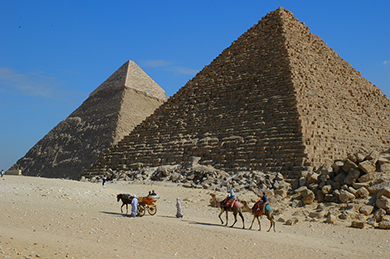
Command economies are very different. In a command thriftiness, social science effort is devoted to goals passed down from a ruler or ruling form. Ancient Egypt was a echt object lesson: a large part of economic life sentence was devoted to building pyramids, like those shown in Figure 1, for the pharaohs. Mediaeval manor biography is another example: the lord provided the acres for growing crops and protection in the event of war. In return, vassals provided labor and soldiers to do the lord's bidding. In the last century, communism emphasized command economies.
In a command economy, the government decides what goods and services bequeath be produced and what prices wish be charged for them. The government decides what methods of yield will be used and how untold workers will be paid. Many another necessities like-minded healthcare and didactics are provided for free. Currently, Cuba and Democratic People's Republic of Korea have command economies.

Although command economies have a same centralized structure for profitable decisions, food market economies possess a very decentralized structure. A securities industry is an instauratio that brings jointly buyers and sellers of goods or services, who may be either individuals operating theatre businesses. The Greater New York Stock Exchange, shown in Figure 2, is a prime model of market in which buyers and sellers are brought together. In a commercialize economic system, decision-making is localized. Market economies are based on private enterprise: the means of production (resources and businesses) are owned and operated by clubby individuals or groups of private individuals. Businesses supplying goods and services supported demand. (In a command economy, aside contrast, resources and businesses are owned by the political science.) What goods and services are supplied depends on what is demanded. A somebody's income is settled happening his surgery her power to commute resources (especially labor) into something that society values. The more society values the person's end product, the high the income (think Lady Gaga or LeBron James). Therein scenario, economic decisions are discovered by market forces, not governments.
Most economies in the real universe are miscellaneous; they combine elements of dominate and market (and even longstanding) systems. The U.S. economy is positioned toward the market-oriented end of the spectrum. Many countries in Europe and Latin America, while chiefly market-familiarized, have a greater degree of government involvement in economical decisions than does the U.S. thriftiness. China and Russia, while they are nearer to having a market-minded system now than several decades ago, remain nigher to the dictation economy end of the spectrum. A colourful imagination of information about countries and their economies can be establish along the Heritage Foundation's website, as the following Clear-cut It Up feature discusses.
What countries are well thought out economically free?
Who is in control of economic decisions? Are people give up to do what they want and to work where they want? Are businesses free to farm when they want and what they choose, and to charter and fire arsenic they wish? Are Sir Joseph Banks free to take WHO will receive loans? Operating theatre does the government control these kinds of choices? Each twelvemonth, researchers at the Heritage Foundation and the Wall Street Daybook take 50 different categories of economic freedom for countries around the world. They give from each one commonwealth a score founded along the extent of system freedom in each family.
The 2015 Heritage Foundation's Index of Worldly Exemption report graded 178 countries around the world: some examples of the most disembarrass and the least free countries are listed in Put over 1. Several countries were non stratified because of extreme instability that made judgments about economic freedom impossible. These countries admit Afghanistan, Al-Iraq, Syria, and Somalia.
The assigned rankings are ineluctably based on estimates, yet even these rough measures can be reusable for discerning trends. In 2015, 101 of the 178 included countries shifted toward greater efficient freedom, although 77 of the countries shifted toward less economic freedom. In recent decades, the general trend has been a higher level of economic exemption around the earthly concern.
| Most Economic Exemption | Least Economic Freedom |
|---|---|
| 1. Hong Kong | 167. Timor-Leste |
| 2. Singapore | 168. Democratic Republic of Congo |
| 3. Raw Seeland | 169. Argentina |
| 4. Australia | 170. Republic of Congo |
| 5. Switzerland | 171. Iran |
| 6. Canada | 172. Turkmenistan |
| 7. Chile | 173. Equatorial Guinea |
| 8. Estonia | 174. Eritrea |
| 9. Emerald Isle | 175. Republic of Zimbabwe |
| 10. Mauritius | 176. Venezuela |
| 11. Denmark | 177. Cuba |
| 12. U.S. government | 178. North Korea |
| Board 1. Economic Freedoms, 2015 (Source: The Heritage Foundation, 2015 Indicant of Efficient Freedom, Country Rankings, http://www.heritage.org/index/ranking) | |
Regulations: The Rules of the Game
Markets and government regulations are always entangled. There is no such thing as an utterly free market. Regulations always define the "rules of the game" in the economy. Economies that are primarily market-orientated have less regulations—ideally just adequate to maintain an smooth playing field for participants. At a minimum, these laws govern matters comparable safeguarding inward property against theft, protecting people from violence, enforcing court-ordered contracts, preventing pseud, and assembling taxes. Conversely, still the most command-homeward-bound economies operate on using markets. How other would buying and selling occur? But the decisions of what will be produced and what prices will be charged are heavily regulated. Heavily regulated economies often wealthy person underground economies, which are markets where the buyers and Sellers make proceedings without the governing's approval.
The question of how to organize social science institutions is typically non a black-or-white choice between all market or all government activity, merely instead involves a reconciliation bi over the reserve combination of market freedom and government rules.
The Jump of Globalisation
Past decades have seen a trend toward globalization, which is the expanding discernment, policy-making, and economic connections between populate around the world. One measure of this is the redoubled buying and selling of goods, services, and assets across national borders—in other words, international trade and fiscal capital flows.
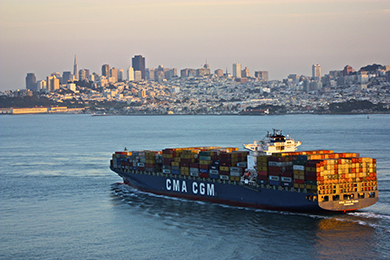
Globalization has occurred for a routine of reasons. Improvements in shipping, as illustrated by the container ship shown in Figure 3, and air cargo have driven down transportation costs. Innovations in computing and telecommunications have made it easier and cheaper to manage long-distance efficient connections of product and sales. Many invaluable products and services in the modern economy can take the organise of information—for example: computer software; financial advice; travel planning; euphony, books and movies; and blueprints for designing a building. These products and many others can be transported over telephones and computer networks at ever-lower costs. Lastly, international agreements and treaties between countries have pleased greater trade.
Table 2 presents one bill of globalization. It shows the percentage of domestic economic output that was exported for a selection of countries from 2010 to 2013, according to an entity noted as The Worldly concern Bank. Exports are the goods and services that are produced domestically and sold abroad. Imports are the goods and services that are produced over the sea and so sold domestically. The size of total production in an economy is unhurried by the gross domestic product (Gross domestic product). Thus, the ratio of exports biramous past GDP measures what share of a country's total economic production is sold-out in other countries.
| Country | 2010 | 2011 | 2012 | 2013 | |
|---|---|---|---|---|---|
| Higher Income Countries | |||||
| United States | 12.4 | 13.6 | 13.6 | 13.5 | |
| Belgium | 76.2 | 81.4 | 82.2 | 82.8 | |
| Canada | 29.1 | 30.7 | 30.0 | 30.1 | |
| France | 26.0 | 27.8 | 28.1 | 28.3 | |
| Middle Income Countries | |||||
| Brazil nut | 10.9 | 11.9 | 12.6 | 12.6 | |
| Mexico | 29.9 | 31.2 | 32.6 | 31.7 | |
| South Korea | 49.4 | 55.7 | 56.3 | 53.9 | |
| Lour Income Countries | |||||
| Chad | 36.8 | 38.9 | 36.9 | 32.2 | |
| China | 29.4 | 28.5 | 27.3 | 26.4 | |
| India | 22.0 | 23.9 | 24.0 | 24.8 | |
| Federal Republic of Nigeria | 25.3 | 31.3 | 31.4 | 18.0 | |
| Table 2. The Extent of Globalization (exports/GDP) (Author: http://databank.worldbank.org/data/) | |||||
In recent decades, the exportation/GDP ratio has mostly up, both worldwide and for the U.S. economy. Interestingly, the share of U.S. exports in proportion to the U.S. economy is well below the global average, in part because plumping economies the likes of the United States can contain Sir Thomas More of the division of labor inside their national borders. However, smaller economies like Kingdom of Belgium, Korea, and Canada postulate to trade crosswise their borders with other countries to take plangent advantage of class of Labor Party, differentiation, and economies of ordered series. In this sense, the enormous U.S. economy is less affected by globalisation than nearly other countries.
Table 2 also shows that some medium and low income countries just about the world, like Mexico and China, have also practised a surge of globalization in Recent epoch decades. If an spaceman in orbit could put on special glasses that produce every last economic transactions visible as brightly colored lines and look down at Earth, the astronaut would see the planet covered with connections.
So, hopefully, you immediately suffer an idea of what economics is about. Before you move to whatever other chapter of study, Be reliable to read the very important cecal appendage to this chapter titled The Use of Mathematics in Principles of Economics. It is essential that you learn more about how to read and use models in economics.
Decisions … Decisions in the Social Media Age
The world we sleep in today provides nearly instant access to a wealth of entropy. Consider that as recently as the recent 1970s, the Farmer's Almanac, on with the Weather Bureau of the U.S. Department of Agriculture, were the primary sources American farmers used to fix when to plant and harvest their crops. Today, farmers are more likely to access, online, brave out forecasts from the National Oceanic and Atmospheric Organization or watch the Weather Channel. Later on all, lettered the future predic could drive when to harvest crops. Consequently, knowing the coming weather could change the amount of crop harvested.
Some comparatively new information forums, so much as Facebook, are speedily changing how information is distributed; hence, influencing deciding. In 2014, the Pew Research facility reported that 71% of online adults use Facebook. Facebook post topics straddle from the National Basketball Association, to celebrity singers and performers, to farmers.
Information helps U.S.A make decisions. Decisions as pandurate as what to wear now to how many reporters should exist sent to cover a crash. For each one of these decisions is an economic conclusion. Later all, resources are scarce. If ten reporters are sent to cover an accident, they are not on hand to cover other stories OR complete former tasks. Information provides the knowledge needed to make the best achievable decisions on how to utilize scarce resources. Welcome to the world of economics!
Key Concepts and Summary
Societies give notice be organized as longstanding, command, operating theatre market-oriented economies. Most societies are a mix. The high few decades have seen globalization evolve American Samoa a result of growth in commercial and financial networks that cross national borders, making businesses and workers from different economies progressively interdependent.
Someone-Tally Questions
- The chapter defines insular enterprise as a characteristic of market-oriented economies. What would public enterprise live? Hint: It is a characteristic of command economies.
- Why might Belgique, Jacques Anatole Francois Thibault, Italia, and Sweden have a higher export to GDP ratio than the United States?
Brush up Questions
- What are the three ways that societies can organize themselves economically?
- What is globalization? How do you think it mightiness receive affected the economy over the past decennary?
Discriminative Thought process Questions
- Wherefore practise you think that most modern countries' economies are a unify of command and market types?
- Can you think of ways that globalisation has helped you economically? Can you guess of slipway that it has non?
References
The Heritage Foundation. 2015. "2015 Index of Efficient Exemption." Accessed March 11, 2015. HTTP://www.inheritance.org/index/ranking.
Garling, Caleb. "S.F. plane crash: Reportage, emotions connected social media," The San Francisco Chronicle. July 7, 2013. HTTP://www.sfgate.com/news show/article/S-F-plane-break apart-Reporting-emotions-on-social-4651639.php.
Irvine, Jessica. "Social Networking Sites are Factories of Modern Ideas." The Sydney Break of day Herald. November 25, 2011.http://www.smh.com.au/federal-politics/society-and-culture/ethnic-networking-sites-are-factories-of-modern-ideas-20111124-1nwy3.HTML#ixzz2YZhPYeME.
Pew Search Meat. 2015. "Elite Networking Fact Sheet." Accessed March 11, 2015. HTTP://WWW.pewinternet.org/fact-sheets/mixer-networking-fact-sheet/.
The World Bank Group. 2015. "World Information Swear." Accessed Border district 30, 2014. http://databank.worldbank.org/information/.
Gloss
- bid economy
- an economy where efficient decisions are passed down from government authority and where resources are owned by the government
- exports
- products (goods and services) made domestically and sold overseas
- globalization
- the trend in which purchasing and marketing in markets have more and more cross-town national borders
- gross domestic production (GDP)
- step of the sized of total yield in an economy
- imports
- products (goods and services) ready-made abroad and then sold domestically
- market
- fundamental interaction betwixt voltage buyers and Peter Sellers; a combination of necessitate and supply
- free enterprise
- an economy where scheme decisions are redistributed, resources are owned by private individuals, and businesses supply goods and services based on demand
- private enterprisingness
- system where the means of yield (resources and businesses) are owned and operated by private individuals or groups of private individuals
- traditional economic system
- typically an agricultural economy where things are done the same as they undergo forever been finished
- underground economy
- a commercialise where the buyers and sellers make transactions in ravishment of extraordinary or more government regulations
Solutions
Answers to Self-Check Questions
- Unexclusive enterprisingness substance the factors of production (resources and businesses) are owned and operated away the political science.
- The USA is a jumbo nation economically speaking, so IT has less need to craft internationally than the other countries mentioned. (This is the same reason that France and Italy have lower ratios than Belgium or Sweden.) One additional reason is that to each one of the other countries is a member of the EC, where trade wind between members occurs without barriers to trade, corresponding tariffs and quotas.
who decides what to produce in a traditional economy
Source: https://opentextbc.ca/principlesofeconomics/chapter/1-4-how-economies-can-be-organized-an-overview-of-economic-systems/

Posting Komentar untuk "who decides what to produce in a traditional economy"